
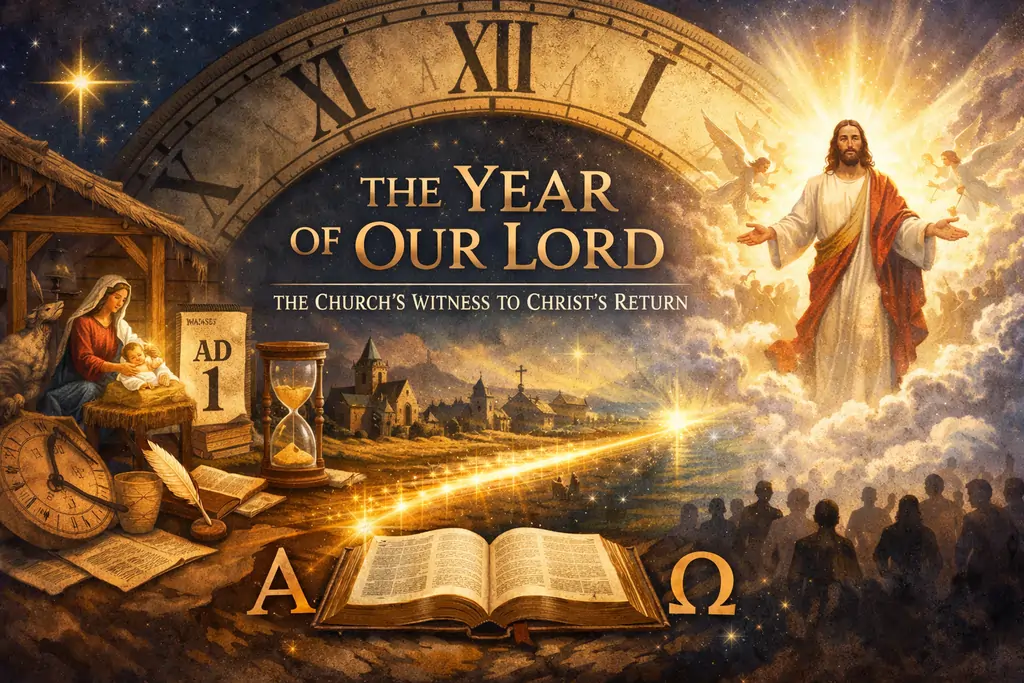
When Time Refuses to Stay Neutral
If time were truly neutral, no one would argue about it. Yet humanity has spent centuries debating calendars, eras, and the naming of years, which suggests that time carries more meaning than we pretend. The phrase In the Year of Our Lord is not an ornamental relic from a more religious age, but a theological claim disguised as a date. It insists that history is not merely happening but is being governed. According to the Oxford Bible Commentary, early Christian thought rejected the idea that time endlessly repeats itself and instead understood history as moving toward fulfillment through divine purpose.
This means that every date written under the Anno Domini system quietly confesses that Christ stands at the center of history. The calendar does not ask permission before making this confession. It simply keeps preaching. Christians historically understood this, which is why dating documents was never a spiritually indifferent act. When believers wrote the year of our Lord, they were also writing a creed, whether they paused to think about it or not.
One might say the Church discovered a way to evangelize even when no one was listening. Time itself became the messenger. The question worth asking is why Christians cared so much about time in the first place. The answer lies not only in the Incarnation but in the expectation that the same Lord who entered time would also return to conclude it.
From the Incarnation to the Calendar
The practice of marking years by the life of Christ took formal shape in the sixth century through the work of Dionysius Exiguus. Easton’s Bible Dictionary explains that Dionysius rejected dating systems based on imperial reigns, particularly those associated with the persecution of Christians. Instead, he anchored chronology to the birth of Christ, thereby asserting that Christ, not Caesar, defines history.
This move was more theological than technical. Dionysius was not merely counting years differently but was redefining what it meant for history to matter. By tying time to Christ, he placed all of human history under the lordship of the Incarnate Son. The fact that Dionysius may have miscalculated the exact year of Christ’s birth does not weaken the theological point. It strengthens it. History belongs to Christ even when our math is imperfect.
The widespread adoption of this system through the work of Bede ensured that the Christian understanding of time shaped Western consciousness. According to Willmington’s Guide to the Bible, the early Church viewed the Incarnation as the decisive turning point in history. Everything before anticipated it, and everything after flowed from it. The calendar thus became a visible reminder that God had entered time and claimed it.
If history has a center, then it also has a direction. This is where the phrase In the Year of Our Lord begins to look less like bookkeeping and more like prophecy.
Linear Time and the Expectation of an Ending
Ancient cultures commonly viewed time as cyclical, repeating patterns with no final resolution. According to Norman Geisler in the Baker Encyclopedia of Christian Apologetics, the idea of linear time originates in Judaism and is spread broadly through Christianity as it takes hold in the Western world. This shift carries enormous theological weight. Linear time implies purpose, movement, and accountability.
If history is moving somewhere, then it must eventually arrive. The New Testament consistently frames Christian existence as life lived in expectation. The Theological Dictionary of the New Testament explains that early believers understood themselves to be living in the final stage of redemptive history, even though the timing of its conclusion remained unknown. This created a posture of watchfulness rather than complacency.
2nd Peter 3:8 reminds believers that the Lord is not bound by human measurements of time. “With the Lord a day is like a thousand years, and a thousand years are like a day.” The Oxford Bible Commentary interprets this passage as reassurance that apparent delay does not negate divine intention. Time is not stalling. It is serving mercy. Each passing year represents both patience and promise. The calendar therefore becomes an eschatological instrument. It marks not only how long the world has existed since Christ but also how long it has been waiting for His return. The Year of Our Lord is not just a count upward but a countdown forward.
Living Between Advent and Return
In The City of God Augustine writes that the Church lives between two comings of Christ, the first in humility and the second in glory. This means Christians inhabit a tension filled stretch of history. Time is no longer empty. It is charged with expectation.
James P. Boyce explains in Abstract of Systematic Theology that Christian history unfolds between these two appearances, shaping both doctrine and daily life. Every year lived under Christ’s lordship is a reminder that the story is unfinished. The calendar quietly reinforces this truth every time a date is written.
Philippians 3:20 states that believers await a Savior from heaven. This waiting is not passive. It is formative. Time trains the Church in patience, hope, and faithfulness.
Modern culture struggles with this kind of waiting. We prefer progress bars and estimated arrival times. The Christian calendar offers neither. It offers instead a promise that the Lord who came will come again. Every year marked In the Year of Our Lord stands as a reminder that history is leaning toward a meeting, not drifting toward meaninglessness.
When the World Keeps Christ’s Time Without Admitting It
One of the quieter ironies of modern life is that even secular institutions continue to date their documents according to Christ’s arrival. According to The Complete Guide to Christian Denominations, Western civilization still orders its chronology around the Christian story, even where belief has faded. This is not sentimentality. It is inheritance.
The calendar bears witness whether people intend it to or not. Every date quietly announces that history pivoted when Christ entered it. Even arguments against Christianity are timestamped with His lordship. Psalm 90 speaks of God’s sovereignty over time itself, a theme Easton’s Bible Dictionary connects to the biblical doctrine of divine eternity. Time belongs to God before belief enters the picture. The calendar is simply honest about it.
Time as a Witness Still Waiting
The phrase, “The Year of Our Lord” is not a conclusion. It is an interval. According to the Oxford Bible Commentary, Christian time moves toward restoration rather than repetition. This movement gives meaning to waiting without dissolving mystery. The Church does not merely endure time. It inhabits it as witness. Each year lived is both testimony and invitation. Revelation 22 records Christ’s promise to come again, a promise that frames all Christian chronology without resolving its tension.
The calendar will not announce the day of the Lord’s return. It will simply stop mattering when that day arrives. Until then, time continues its quiet sermon. Every year says the same thing. Christ has come. Christ reigns. Christ will return.
The question that lingers is not how many years have passed. It is how we are living in the one we have been given.
References
Augustine of Hippo. (n.d.). The City of God. Translated editions commonly used in Christian theological study.
Boyce, J. P. (1887). Abstract of Systematic Theology. Philadelphia, PA: American Baptist Publication Society.
Easton, M. G. (1897). Easton’s Bible Dictionary. London: T. Nelson and Sons.
Geisler, N. L. (1999). Baker Encyclopedia of Christian Apologetics. Grand Rapids, MI: Baker Books.
The Oxford Bible Commentary. (2001). Edited by J. Barton and J. Muddiman. Oxford, UK: Oxford University Press.
Willmington, H. L. (1981). Willmington’s Guide to the Bible. Wheaton, IL: Tyndale House Publishers.
Theological Dictionary of the New Testament. (1964–1976). Edited by G. Kittel and G. Friedrich. Grand Rapids, MI: Eerdmans.
The Holy Bible, English Standard Version. (2001). Wheaton, IL: Crossway.